
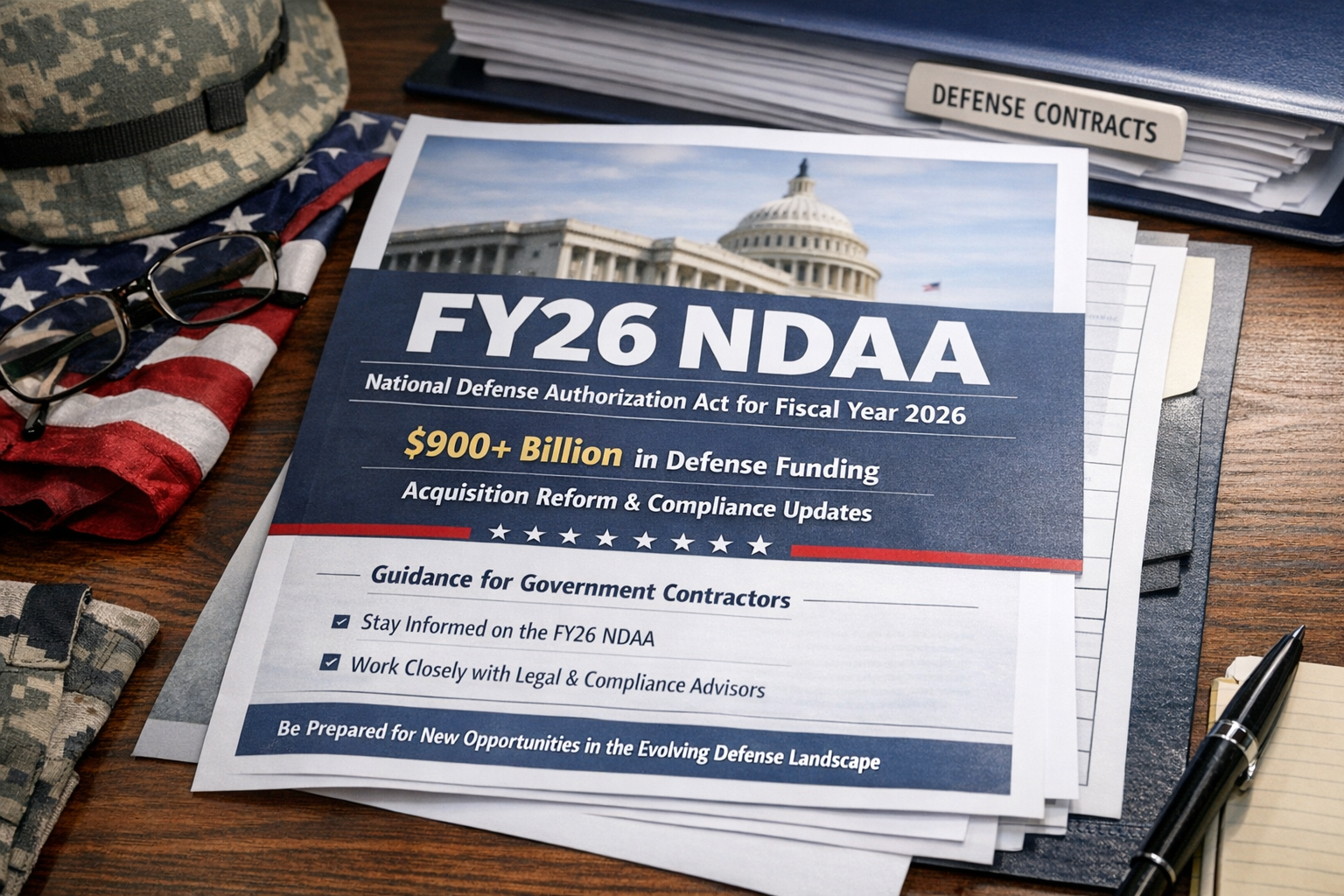
Key Details: Last December, President Trump signed the National Defense Authorization Act for Fiscal Year 2026 (FY26 NDAA) into law. This legislation authorized over $900 billion in defense funding and contains numerous acquisition reform provisions and critical updates affecting government contractors. Government contractors are encouraged to familiarize themselves with the FY26 NDAA and to work closely with their legal and compliance advisors to ensure they remain well positioned to capitalize on new opportunities in the evolving defense contracting landscape.
Background on the NDAA
The NDAA is an annual federal law that authorizes funding and sets out policies for the Department of War (DoW) and national security programs. The NDAA has been enacted each year for over 60 years and shapes US defense and procurement policies. In addition to establishing the budget for military and defense programs, the NDAA often introduces policy reforms that impact how defense contracts are awarded and managed. In recent years, the NDAA has put special emphasis on modernizing acquisition processes, supporting small businesses, promoting emerging technologies, and enhancing efficiency and accountability in defense contracting. The FY26 NDAA continues this trend, delivering sweeping changes that defense contractors must understand to remain compliant.
Key Sections
Commercial-First Acquisition Strategy
The FY26 NDAA pushes the DoW to adopt a more commercial-like approach to buying goods and services. It elevates “best value” over low-cost bidding under Section 1801 and ensures that commercial products and services are preferred unless no viable commercial options exist. The NDAA also restricts the flow-down of unique defense clauses to commercial subcontracts, thereby encouraging greater participation by commercial companies. These changes are designed to accelerate the transition from prototype to production and broaden competition by making it easier for nontraditional defense contractors to enter the defense marketplace.
Increase Competition by Nontraditional Defense Contractors
The 2026 NDAA includes several initiatives to expand access to defense contracting opportunities for small businesses and nontraditional defense contractors (NDCs). Section 824 directs the Department of War to broaden its approach to evaluating past performance. Within one year, the Secretary of War must issue guidance on when the DoW should consider a wider array of past performance examples—such as commercial or non-government projects—particularly for requirements with limited precedent. The guidance must also address how to validate non-government references and encourage alternative evaluation methods, such as technology demonstrations and testing, when traditional past performance data is lacking.
In addition, Section 824 mandates that the Defense Acquisition Regulations Council solicit public input to identify outdated, overly burdensome, or misaligned procurement policies that hinder small business and NDC participation or inflate bid and proposal costs. Based on this feedback, the Council must recommend legislative, regulatory, or procedural changes to enhance competition and reduce barriers. The Secretary of War is then required to implement these changes within two years.
Raised Thresholds
To reduce administrative burdens and promote efficiency, the NDAA significantly increases several key thresholds. Section 1804 raises the threshold for certified cost or pricing data under the Truth in Negotiations Act (TINA) from $2.5 million to $10 million. This also increases the sole-source approval threshold from $10 million to $100 million.
Section 1806 also raises the Cost Accounting Standards (CAS) applicability threshold from $2.5 million to $35 million, with full CAS coverage now required only for contracts that exceed $100 million. These changes are intended to ease compliance requirements for mid-sized contractors and speed up acquisition timelines. Contractors previously subject to CAS or TINA requirements may now find themselves exempt. However, contractors are encouraged to remain vigilant regarding compliance thresholds and requirements as post-award scrutiny may increase.
Innovation and R&D Expansion
The NDAA boosts federal investment in emerging technologies, including artificial intelligence (AI), autonomous systems, and advanced materials. Section 1823 expands the use of Commercial Solutions Openings (CSOs), allowing for more flexible acquisition of commercial technologies. Section 1826 provides broad exemptions for nontraditional defense contractors from certain cost accounting and pricing rules, making it easier for innovative firms to enter the market. These provisions open new doors for startups, universities, and technology firms to compete for defense contracts.
Cybersecurity Focus
Cybersecurity remains a top priority for 2026 with Section 866 requiring the DoW to harmonize cybersecurity requirements across the defense industrial base by June 1, 2026. The goal is to eliminate duplicative or inconsistent cybersecurity regulations and move toward a more uniform cybersecurity framework. This includes aligning requirements such as CMMC, DFARS clauses, and other DoW specific requirements into a uniform standard. Contractors should expect increased emphasis on documentation and governance and focus on aligning with CMMC controls early.
Supply Chain Transparency and Resilience
The NDAA reinforces the importance of secure and visible supply chains with Section 833 introducing a supply chain illumination framework that rewards contractors who proactively disclose noncompliant items and implement corrective action plans. This provision creates a strong incentive for transparency, as contractors who demonstrate good-faith efforts to address supply chain risks may be eligible for “national security waivers” when they are promptly disclosed.
Deterring Frivolous Bid Protests
To discourage speculative protests, Section 875 allows contracting officers to withhold up to 5% of payments from incumbent contractors who file protests later dismissed for lack of legal or factual merit. This provision aims to reduce delays and promote fair competition by penalizing protests used primarily to extend incumbent contracts or delay transitions.
Implementation
Typically, NDAA provisions are implemented through DFARS revisions or other regulatory updates. Contractors are encouraged to stay updated on implementation provisions during the rulemaking process.
Conclusion and Action Plan
The FY26 NDAA marks a pivotal shift in how the DoW approaches acquisition, innovation, and resilience. For government contractors, especially small businesses and nontraditional defense contractors, this year’s legislation opens new doors while raising the bar on compliance. Understanding these changes is essential to remaining competitive and seizing opportunities. Contractors are encouraged to review the following action items:
- Review your current contract portfolio to identify where raised thresholds (e.g., TINA and CAS) may reduce compliance burdens or create new bidding opportunities.
- Evaluate your past performance documentation and prepare to leverage it under expanded evaluation criteria.
- Audit your supply chain for potential noncompliant components or vendors.
- Assess your cybersecurity infrastructure and ensure adherence to necessary regulations.
- Explore participation in Commercial Solutions Openings and other flexible acquisition pathways that now offer streamlined entry points for innovative technologies.
- Stay updated on the rulemaking process to implement NDAA provisions.
For further information and expertise, contact Ryan & Wetmore today.
Today’s Thought Leaders

About Peter Ryan
Partner, Co-founder, & CPA
Peter T. Ryan co-founded Ryan & Wetmore in 1988 with business partner Michael J. Wetmore. Peter provides clients with the best strategies for success. His expertise extends across various industries. Peter obtained a Master of Business Administration in Finance from the University of Baltimore and a Bachelor of Arts in Accounting from the Catholic University of America.

About Rosie Cheng
Senior Finance Consultant
Rosie Cheng is a Senior Finance Consultant at Ryan & Wetmore. She focuses on government contracting services and produces many of the firm’s government contracting newsletters. Rosie earned her Master of Science in Management from Georgetown University and a BBA from William and Mary.